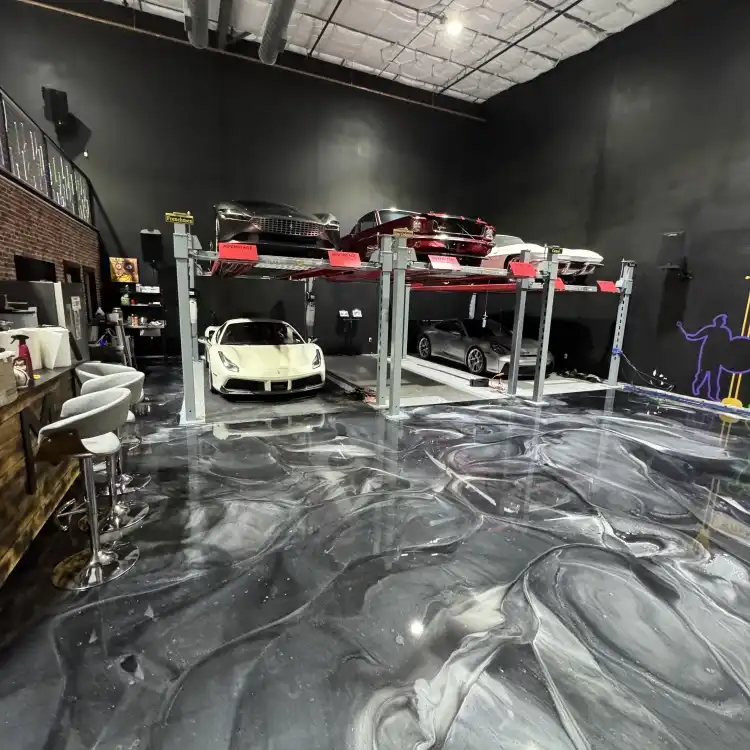
Commercial epoxy suits Friendswood retail, restaurant, clinic, and light-warehouse floors along FM 518 and FM 2351. Retail and offices are the entry tier per square foot, restaurants step up for slip-rated health-code topcoats, and light industrial tops the range for load ratings. We install after hours or in phases so you never lose a business day, and every job comes with insurance, warranty, and photo documentation.
Friendswood’s business corridors along FM 518 and FM 2351 are full of small-format commercial spaces: neighborhood retail, dental and medical offices, salons, boutique fitness studios, restaurants, and light-industrial shops. Each one asks something different from its floor, and the wrong choice fails fast under commercial traffic. This post covers how commercial epoxy works for these Friendswood spaces, how we install without closing your doors, and what it actually costs. Our Friendswood commercial epoxy page has the full detail.
Matching the System to the Space
There is no single commercial recipe. A medical or dental office needs a seamless, sanitary floor with a coved base and no grout lines to trap bacteria. A restaurant kitchen needs a slip-rated, grease-resistant surface that passes a health inspection. A retail sales floor wants a bright, clean finish that photographs well and hides scuffs between mop cycles. A light-warehouse or shop floor needs abrasion resistance and a load rating for carts and the occasional pallet jack. We read your slab and your real traffic before we spec anything.
Installing Without Closing Your Doors
Losing a sales day is expensive, so most Friendswood commercial floors go in after hours or on weekends. A common pattern is a Friday-close to Monday-open turnaround for a full sales floor reset, or a single overnight for a smaller suite. For larger spaces we phase the work: coat half the floor, cure it, reopen it, then close and coat the other half. In a light-warehouse we can often keep part of the operation running throughout. Your customers never see a closed sign.
Passing a Friendswood Health Inspection
Food-service floors have to satisfy an inspector, and we build to that standard. Restaurant kitchens and prep areas get a slip-rated polyaspartic topcoat that meets NSF and FDA cleanability standards, with a coved base where the code calls for it so there is no floor-to-wall crevice to harbor grime. We spec to City of Friendswood and Galveston County health-code requirements and hand over the product data sheets your inspector may ask for. The floor becomes an asset at inspection time, not a liability.
What Commercial Epoxy Costs in Friendswood
Pricing tracks the demands of the space. Retail and office sales floors are the entry tier per square foot. Restaurants run higher because of the coving and slip-rated topcoats. Fitness and gym floors run higher still for thicker, shock-absorbing builds. Light-industrial and warehouse floors top the range depending on load ratings and abrasion demands. Every number follows an on-site measurement of the slab, its moisture, and its prep condition, and the quote is itemized so you see exactly what you are paying for.
Working With Property Managers and Tenants
Landlords and property managers along FM 518 and FM 2351 want a paper trail, and we bring one to every job: a certificate of insurance, a written warranty tied to the exact system installed, and dated photos of every prep and coating stage. In a multi-tenant strip we coordinate shared HVAC, dumpster access, and after-hours entry with the neighbors so nobody gets surprised. When a build-out or a change of use triggers a City of Friendswood permit or a county inspection, we pull it and stay in the loop until it clears. Commercial systems carry a 7 to 10 year warranty, or 5 years on high-traffic industrial.
How the Commercial System Is Actually Built
A commercial floor is a stack of layers spec’d to the room, not a single product. On a Friendswood retail or office slab we usually run a 100 percent solids epoxy primer at 6 to 8 mils, a high-build epoxy body at 15 to 25 mils, and a slip-rated polyaspartic topcoat, finishing around 25 to 40 mils. A restaurant kitchen or wash-down area steps up to a quartz-broadcast body layer for texture and thickness, often 40 to 60 mils, with coving up the wall. A light-warehouse floor with forklift or pallet-jack traffic gets a heavier industrial build, sometimes 80-plus mils, rated for the point loads it carries. Reading the traffic and the cleaning chemistry a space will see is what decides those numbers, and it is why we measure before we ever quote a commercial floor.
Moisture and Prep on a Bigger Slab
The bigger the slab, the more moisture and prep decide the outcome. Most Friendswood commercial buildings are slab-on-grade over clay soil near the Clear Creek drainage, so they push ground vapor upward, and an epoxy build trapped over a damp slab pops off in sheets within a year. We probe every commercial slab with a calcium chloride or relative-humidity test and add a moisture-mitigation primer when the reading is over the limit. Prep scales up too: a clean retail slab gets a dust-controlled diamond grind, but a floor buried under old tile mastic, cured epoxy, or a hard sealer gets shot blasted instead, which fires steel shot to leave the aggressive profile a heavy commercial build needs to grip. On a commercial job, guessing at moisture or forcing the wrong prep tool is how a floor gets bought twice.
Downtime Is the Real Cost, Not the Coating
For a Friendswood business, the coating price is rarely the number that matters most, the lost operating days are. That is why we build the schedule around your hours from the start. A boutique retail suite might reset over a single Friday-close to Monday-open weekend. A restaurant closes for a short overnight run on the kitchen, phased so the dining room can reopen while the back of house cures. A light-warehouse keeps half its operation running while we coat the other half, then swaps. When we quote a commercial floor, we quote the schedule as carefully as the system, because a floor that shuts you down for a week to save a few hundred dollars is the expensive option, not the cheap one.
The Paper Trail a Commercial Job Needs
Commercial work comes with obligations a garage job never has, and we handle them so you do not have to chase us for them. Every Friendswood commercial floor ships with a certificate of insurance naming the property, a written warranty tied to the exact system installed rather than a vague lifetime promise, and dated photos of each prep and coating stage in case a landlord, insurer, or future tenant ever asks. In a multi-tenant strip along FM 518 we coordinate shared HVAC, dumpster access, and after-hours entry with the neighboring businesses so nobody is surprised by a grinder running at ten at night. And when a build-out or a change of use triggers a City of Friendswood permit or a Galveston County inspection, we pull the permit and stay in the loop until it clears. On a commercial floor, the documentation is part of the deliverable, not an afterthought.
Friendswood Commercial Epoxy FAQ
Do you have to close my Friendswood business to install?
Rarely. Retail, restaurants, and offices get installed after hours or on weekends, and light-industrial shops can often stay partly open in a phased sequence built around your operating hours.
Will the floor pass a health inspection?
Yes. Food-prep areas get a slip-rated polyaspartic topcoat meeting NSF and FDA cleanability standards with a coved base where required, spec’d to City of Friendswood and Galveston County code.
What warranty comes with a commercial floor?
Standard commercial systems carry a 7 to 10 year written material and labor warranty; high-traffic industrial carries 5 years. The warranty names the exact system installed.
Can you handle a light-warehouse floor with forklift traffic?
Yes, with a heavier industrial spec, typically an 80-plus mil system rated for the load. We measure the traffic and abrasion demands before quoting so the build matches the use.
Can you provide commercial references?
Yes, on request, including phone numbers and project addresses. We have completed retail, restaurant, salon, clinic, and light-industrial floors across Friendswood, League City, and Galveston County.
How thick is a commercial floor compared to a garage floor?
It depends on the space. A retail or office floor runs about 25 to 40 mils, a restaurant or wash-down area 40 to 60 mils with quartz and coving, and a light-warehouse with forklift traffic can be 80-plus mils rated for the load. A residential garage, by contrast, is usually 25 to 30 mils. We measure the traffic and cleaning demands before spec’ing the thickness so the build matches the use.
Do you shot blast or diamond grind a commercial slab?
Both, depending on the floor. A clean, sound Friendswood retail slab gets a dust-controlled diamond grind. A slab buried under old tile mastic, cured epoxy, or a hard sealer gets shot blasted instead, which leaves a more aggressive profile that a heavy commercial build needs to bond to. Picking the right prep method for the specific slab is judgment, not a one-size checklist.
Need a Commercial Floor in Friendswood?
After-hours installs, health-code topcoats, full documentation. Local FM 2351 shop, 12+ years in Galveston County.
Finish My Floor (346) 624-0125Read our full Friendswood Commercial Epoxy page · Friendswood services · Get a free quote