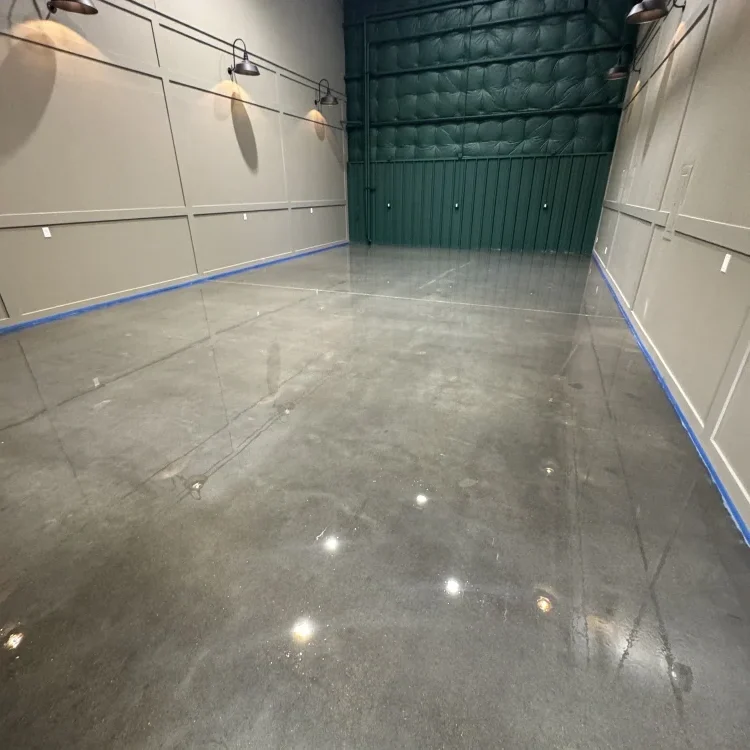
Not a coating. The slab itself, refined to a finish.
Polished concrete is a different category of floor. No epoxy, no chips, no topcoat. We take the slab you already own and run it through a multi-step diamond grind and densify process that transforms the surface into a hard, dust-proof, reflective finish. Warehouses, retail, restaurants, offices, and modern homes across Houston. Lowest total cost of ownership of any floor we install.
Use the slab you already paid for.
Polished concrete is the answer for owners who want the longest service life at the lowest total cost. Instead of applying a coating that has to be stripped and replaced every 10 to 15 years, we refine the existing slab into its own finish. The result is a hard, dense, reflective surface that outlasts the building. A polished floor installed today will be the same polished floor 50 years from now. Clean it with water, and the surface looks new.
That permanence is why polished concrete dominates commercial logistics. Every Amazon warehouse, every Home Depot you have walked through, every modern food hall with a cement-looking floor, they are running polished concrete. The total cost of ownership beats tile, vinyl, terrazzo, and every coating system we install. No recoat, no peel, no discoloration over time. Just the slab, worked harder.
Polishing also scales better than anything else we do. Most of the cost is mobilization and the first grinding passes, so the bigger the footprint, the further that setup spreads and the better the number gets per foot. That is why a warehouse or a distribution floor is where polished concrete really pulls away from tile and vinyl, which price out roughly the same whether you are covering one room or an acre. On the front end, what moves your quote is slab condition more than size. Tile mastic, old glue, oil saturation, spalling, and joint repair all add passes before we ever reach the finish grit. We walk the slab, tell you what it needs, and put every one of those items on the quote in writing before we schedule anything.
We run the Lavina multi-step diamond system, starting at a coarse metal-bond diamond to flatten the slab and opening the pores, then stepping through progressively finer resin-bond grits. Between steps, we apply a lithium-silicate chemical densifier that penetrates the concrete and hardens the calcium-silicate-hydrate matrix from within. By the time we hit the final grit, the floor is physically denser, harder, and more wear-resistant than the raw slab we started with.
Houston slabs bring specific challenges. Clay soil creates joint movement that can telegraph through a polish. Older commercial slabs often have oil contamination that needs remediation before we grind. We walk every slab during the quote and tell you what is achievable with the concrete you have. Sometimes the honest answer is that the slab is too far gone for polish and a topical coating is the better call. We would rather tell you that up front than polish a floor that cannot hold the finish. See our polish portfolio for slab conditions that worked.
“Polished concrete is the most honest floor I install. No coating to hide behind. Either the slab is ready or it is not. Either the grind ladder is right or it is not. You can see every decision we made the second the lights come up in the room.”Justin Thurmon, Owner
Four stages. Every job.
Every polished concrete job we install follows the same four-stage flow. The number of grit steps inside each stage varies by the gloss level you want, but the sequence is fixed.
Assess & Remediate
Walk the slab. Identify oil, tile mastic, cracks, and joint issues. Remediate before grinding. Lay out control lines.
Coarse Grind
Metal-bond diamonds at 30 and 80 grit flatten the slab and open the pore structure. Full HEPA dust containment.
Densify & Polish
Lithium-silicate densifier, then resin-bond diamonds at 100, 200, 400, 800 grit. Finer grits for higher gloss.
Guard & Finish
Surface guard application that beads water and oil. Final buff. Ready for traffic as soon as guard cures.
The grit ladder defines the finish.
Every polished concrete project is quoted by the final grit level, which controls how reflective the floor becomes. Here is how the four standard finishes compare and where each one fits. Warehouses typically stop at 400. Retail and restaurants land at 800. Showrooms and modern homes push to 3000.
Matte, industrial read
Low reflection, utilitarian look. Good for warehouses, back-of-house storage, service bays. Durability is the same as higher grits. Only the reflectivity changes.
Soft reflection
The standard warehouse finish and a common retail back-of-house spec. Reflects overhead lighting without a mirror effect. Hides foot traffic marks better than higher grits.
Clear reflection, no distortion
Retail, restaurants, and modern office interiors live here. Enough reflection to look polished, not so much that fingerprints and foot marks become the feature.
Mirror finish
Showrooms, luxury homes, galleries. True mirror reflection. Every step shows every smudge, so it goes into rooms that get real cleaning attention.
Straight answers on the slab itself.
How is polished concrete different from sealed or coated concrete?
Polished concrete has no topical layer. The finish you see is the slab itself, refined through multi-step diamond grinding and densified with lithium silicate that penetrates the concrete. Sealed or coated concrete has an acrylic, epoxy, or polyaspartic film on top of the slab that will eventually wear, peel, or yellow. A polished floor is the slab, period.
Does my existing slab need to be new or perfect?
No, but it needs to be a candidate. Typical polish candidates are slabs five years old or older that have cured fully, are free of major structural cracks, and do not have tile mastic or oil saturation. Fresh slabs often polish unevenly because the surface cream has not hydrated completely. We walk the slab during the quote and tell you whether polishing is the right call or whether a topical coating would serve you better.
Can I add color to polished concrete?
Yes. Water-based or acetone-based concrete dyes applied between grit steps add integral color without affecting the surface durability. Colors range from earth tones through cool grays and bold saturated hues. We mock up a sample in a closet or back corner so you can approve the color before we hit the main floor. For variegated, organic looks, we usually recommend stained concrete instead. For uniform color, dyed polish wins.
How long does a polished concrete job take?
Most residential and small commercial polishes run two to four days on site. A 5,000 square foot retail floor typically takes four to six days. Large warehouses over 20,000 square feet can run a week or more, usually in scheduled phases so operations continue around us. We publish a schedule before we start and stick to it. Polishing is loud and dusty while it happens, so we coordinate with your operations team on access and noise windows.
How do I maintain a polished concrete floor?
Dust mop daily, damp mop with a neutral pH cleaner weekly. That is it. No waxing, no stripping, no resealing. The guard coat refreshes every three to five years in high-traffic commercial environments, but the polish itself does not need maintenance. Compared to tile grout or vinyl floor wax cycles, polished concrete has the lowest maintenance cost of any commercial floor we install.
Can polished concrete be done over radiant heat?
Yes, and it is actually an ideal pairing. The thermal mass of a polished slab distributes radiant heat evenly across the room with minimal lag. For modern homes with in-floor heat, polished concrete outperforms wood, tile, and carpet on heat delivery and long-term maintenance. Send us your slab plan if you are building new and we will confirm feasibility before the slab gets poured.
Get a quote on your polished concrete project.
Justin or a senior specialist will reach out within one business day. No pressure, no marketing-speak.
- On-site or photo-based quote
- Honest answers about your slab
- Sample boards available on request
Prefer to talk? Call (346) 624-0125
 +30
+30
Want a floor that lasts the life of the building?
Free polished concrete quote. Honest assessment of whether your slab is a candidate.
Coverage across the South Houston metro.
Elite Coatings installs this system throughout Harris, Galveston, and Brazoria counties, from Friendswood out to downtown Houston, Pearland, and the Galveston Bay coast. Our service radius is roughly 50 miles from our Friendswood shop.
Not sure if we reach you? Browse all service areas or ask Justin directly.