Galveston Commercial Epoxy
A commercial floor on the island has a harder job than the same floor in Houston. Salt air comes through the door on every customer, humidity never really drops, and the slab underneath is pushing moisture up at it year round. The specification has to answer all three or it fails in a season.
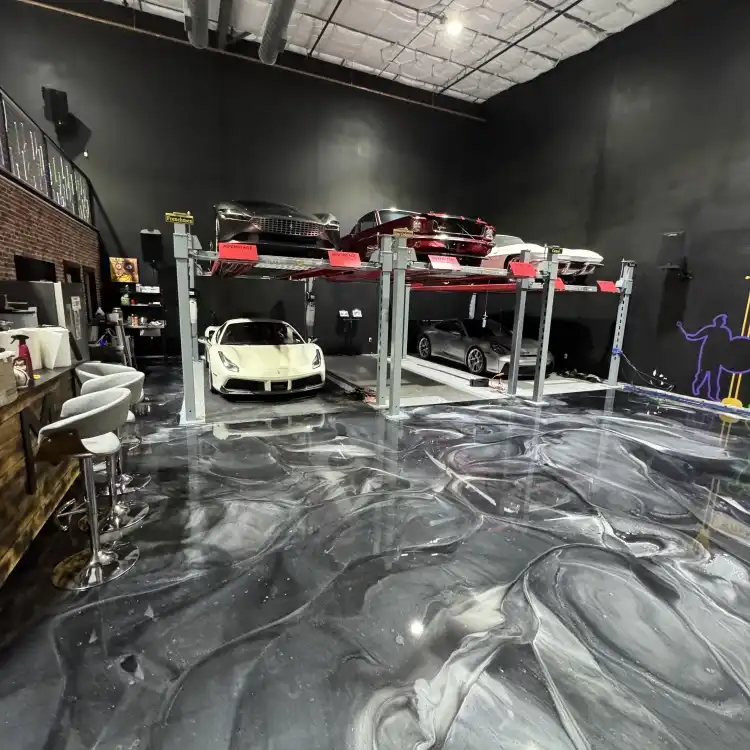
Why island commercial floors fail early
Galveston is our most demanding environment and the reason is under the slab rather than on it. Island construction is slab-on-grade with the water table close beneath, so concrete here pushes moisture vapor upward continuously. There is no freeze-thaw to worry about, which is the one break the climate gives us, but constant vapor drive is harder on a coating than a Texas winter ever was.
What that looks like in practice is a floor that goes down beautifully and starts blistering along the middle six months later. The blisters are vapor pressure lifting the film off concrete it never truly bonded to, because nobody measured what the slab was doing before choosing a system.
So every island install starts with a calcium-chloride or relative humidity test, not a visual call. If the numbers come back high the system changes: an epoxy moisture barrier goes down first, which costs more and is the difference between a floor that holds for a decade and one that fails before the next season starts.
What island commercial work has to handle
Vapor drive from below
The defining island problem. Measured on every job, and where it reads high a moisture barrier primer goes down before anything else.
Salt air through the door
Every customer tracks it in and it concentrates in entry zones. Those runs get the same build as the rest of the floor rather than being treated as edge work.
Direct Gulf sun
Storefronts and anything behind glass need UV-stable topcoats. Standard clear ambers and chalks in this light, and on a light floor it shows within a year.
Seasonal trade
The island runs hard through summer and quiet in winter. Most commercial installs here get booked into the shoulder season so nobody loses a peak week.
Working around a seasonal business
Galveston trade is seasonal in a way most of our mainland work is not. A Strand storefront or a seawall restaurant makes its year between spring break and Labor Day, and closing for four days in June costs far more than the floor. Winter is when the island gets quiet and it is when most of this work should happen.
When the schedule cannot wait, we install overnight or across a weekend using fast-cure systems that take foot traffic in hours rather than days. Larger floors get phased so half the space stays usable, with break lines planned to land under a fixture or a wall rather than across open floor.
Book the floor for February and you lose nothing. Book it for July and the downtime costs more than the install.
One thing worth saying about hurricane season, because it shapes the calendar here more than anything else. Between June and November we keep some scheduling flexibility rather than booking solid, because a named storm means the island evacuates and nothing gets installed that week. Clients who book winter work avoid that entirely, and clients who need summer work get told honestly that a storm can move their date.
The other island reality is that a lot of commercial space here has been flooded at some point. That history matters: a slab that has taken salt water repeatedly behaves differently from one that has not, and previous owners often coated over damage rather than repairing it. We grind a test patch before quoting anything of size, because finding two failed coatings and a soft slab halfway through a job helps nobody.
The specification depends on the room. A restaurant kitchen needs coved base, a seamless surface with no grout line, and a slip rating that works with grease and water on the floor. A retail space needs something that survives sand tracked in from the beach, which is more abrasive than most operators expect. A clinic or office needs chemical resistance matched to whatever gets used to clean it daily.
We write a fixed number after walking the space, with the moisture test result on the proposal so you can see what drove the system choice. If the slab needs mitigation, that is a separate line rather than something folded in quietly.
Island commercial spaces often need more than one system. Back-of-house usually takes flake, front-of-house sometimes takes metallic or polished concrete. Full detail on the main commercial epoxy page. We cover Galveston and Galveston County.
Galveston Commercial Epoxy FAQ
Do you have to close my business to install?
Rarely. Retail, restaurants and offices get installed after hours or across a weekend with fast-cure systems that take foot traffic in hours. Light-industrial spaces can often stay open in a phased sequence. Tell us your season and your hours first, because on this island the right answer is usually to book the work for winter and lose nothing at all.
Why does every island quote start with a moisture test?
Because Galveston slabs sit close to the water table and push vapor upward continuously, and a coating over an untested slab blisters from underneath. The test is calcium chloride or relative humidity, it takes a day, and it decides whether you need a moisture barrier primer. Skipping it is how a floor fails in its first year.
Will salt air damage the floor?
Not the finished coating, which is sealed. What salt does is concentrate in entry zones where it gets tracked in, so those areas take the most wear. We build entry runs to the same specification as the rest of the floor rather than thinning them out, and an occasional rinse in those zones keeps them looking right.
How long does a commercial floor last here?
Ten to twenty years for the resin layer with the moisture handled properly, which is the whole caveat. The topcoat is the wear surface and can be refreshed at roughly the ten-year mark on a busy floor without redoing the system. Floors that skipped the moisture step do not reach those numbers.
Can you match our brand colors?
Generally yes within the range the systems come in, and we can inlay walkway lines and safety markings directly into the floor rather than painting them on. Exact corporate color matching is possible with lead time, so mention it early if it matters.
Do you work after a storm?
Yes, and it is a real part of island work. What matters after flooding is not rushing: a slab that took water needs to dry and be retested before anything goes over it, and that can take weeks. Anyone offering to coat a recently flooded slab immediately is setting up a failure.
Commercial epoxy for your Galveston space
Tell us the square footage, what the space is used for, and which weeks you genuinely cannot close. We will test the slab and put a fixed number in writing.
Finished island floors are in the gallery, or send the details over.