When a Damp Slab Says Polish Instead of Coat
Every coating is a film bonded to the slab, and a film is something vapor pressure can lift. Polishing is different in kind: it grinds and chemically hardens the concrete itself, so there is nothing sitting on top to blister. On island slabs with high moisture readings that makes polished concrete the honest recommendation rather than a style preference, and it asks close to nothing of you afterward.
There is a point in a Galveston walkthrough where the moisture number comes back high enough that the conversation changes. A coating is still possible, but it now needs mitigation and that costs real money. Polishing sidesteps the whole argument, because it does not put anything on the slab for vapor to push against. That is the case for it here, along with the honest limits.
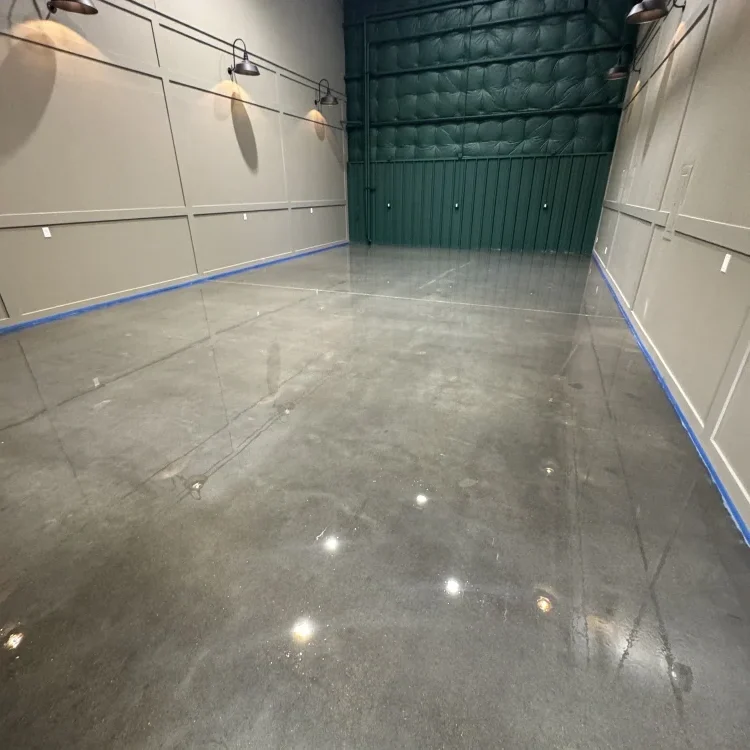
No Film, Nothing to Lift
Every other system we install is a film bonded to concrete, and every one of them can be lifted by vapor pressure if the moisture underneath is not handled. That is the defining island problem, and it is why our Galveston work starts with a test rather than a visual call.
Polishing works differently. It grinds and chemically hardens the concrete itself, so the slab becomes the finished floor. There is no film, so there is nothing to blister and nothing to delaminate. The vapor keeps moving through the slab the way it always did and nothing is standing in its way.
On some island slabs the numbers come back high enough that a coating would need expensive mitigation to survive. Rather than fighting the vapor, polishing lets the slab keep breathing while still giving a hard, sealed, cleanable surface. It deserves to be part of the conversation on this island more often than it is, and it very rarely comes up because it is not the system anyone makes the most money selling.
Densifiers and What Actually Makes It Hard
Polishing is a sequence of diamond passes running from coarse to fine. How many passes and how fine they go is what decides the gloss level, and it is also most of what decides the price.
Between those passes comes the densifier, a chemical hardener that soaks into the concrete and reacts with it. That is the part people misunderstand. It is not a coating and it is not a sealer sitting on top. It makes the surface durable from within, which is why there is no layer that can wear off or peel.
Then a penetrating guard, which also soaks in rather than building a film. Nothing to peel, nothing to recoat on a schedule, and no service contract selling you a refresh every couple of years.
Exposure is a choice made at the walkthrough rather than a technical default. A cream finish keeps the surface as poured. Salt and pepper shows the fine aggregate. Full exposure shows the stone. Those three read very differently in a finished room and it is worth seeing them before deciding.
What Polishing Reveals Instead of Covering
Here is the honest limit. Polishing reveals the concrete rather than covering it. Patch history, color variation and aggregate exposure all show up in the finished floor.
On a sound modern slab that reads beautifully, and the variation is the point rather than a flaw. On a heavily repaired island slab it can look blotchy, and we will say so at the walkthrough rather than delivering that result and calling it character.
That is why we grind a test patch where it matters. You get to see what your actual slab looks like polished before committing to anything, which is a better basis for a decision than a photograph of somebody else’s concrete.
A coating gives you color choice and covers what is underneath. Polishing gives you durability and honesty about what the concrete actually is. Where a slab will not polish evenly, commercial epoxy is the better recommendation and we will make it.
Living With It in Gulf Humidity
Maintenance is close to nothing, and that is the strongest practical argument for it on the island. A damp mop, and a burnish every few years on a commercial floor to lift the sheen back up in the traffic lanes.
No waxing. No sealing. No annual contract. No topcoat to refresh at year ten. Over the life of a building it is the cheapest floor we install to own, which matters in a place where a restaurant or retail space is already fighting sand, salt and humidity every single day.
Salt and sand are handled well for a straightforward reason: there is no film for either to attack or abrade away. Sand tracked across a polished floor does not wear a coating off, because there is no coating. The densified surface is the concrete itself, hardened, and it takes island conditions better than most people assume.
Slipperiness is less of an issue than people expect, and less than polished stone or sealed vinyl. Where a floor gets wet regularly, and on this island many do, we add a penetrating anti-slip treatment. It does not change how the floor looks, because there is no film to alter.
Flooding, Weather and Scheduling
Polished concrete handles flooding better than anything else we install. A polished slab that goes under water dries out and is still a polished slab, because the finish is the concrete itself rather than something bonded on top that water can get beneath.
On an island where flooding is a question of when rather than whether, that is worth weighing properly rather than treating as a footnote. It is a real difference in outcome, not a marketing line.
It is also the least weather-sensitive system we install, which suits the island calendar. Nothing is gelling on a clock, so humidity does not compress a working window and we are not chasing a forecast to get a pour down. The one thing conditions genuinely affect is the densifier soaking in properly, so we do not polish a slab that is still wet.
Timing depends on the number of grind passes and the target gloss rather than on square footage. The walkthrough sets both, and the proposal carries a firm number and a schedule rather than a range. More detail is on the Galveston polished concrete page.
What Building Owners Ask
Is polishing really better on a damp island slab?
On a slab with high moisture readings, often yes. Every coating is a film that vapor pressure can lift, and mitigating that costs real money. Polishing has no film, so there is nothing to lift. It is not always the right answer, but it belongs in the conversation here.
Will my slab polish well?
That is what the walkthrough answers, and we grind a test patch where it matters. A sound slab polishes beautifully. Heavy patching, surface damage or aggregate already exposed in places will polish unevenly, and in those rooms a coating is the better call.
Can you polish a slab that was coated before?
Once the old coating is fully removed, usually yes, but that removal is the job. Grinding off a failed epoxy takes real time and occasionally reveals a slab that will not polish evenly underneath. Better to find that with a test patch than halfway through.
See what your slab looks like polished
We grind a test patch so you can look at your own concrete before committing to anything. Then we put a firm number and a schedule in writing.
Finish My Floor Call Justin (346) 624-0125Finished island floors are in the gallery, or send over the details and we will come out and price the work.