Kemah Stained Concrete
Stain doesn’t sit on top of a slab the way paint or epoxy does. It works down into the concrete and pulls color out of what is already there, so the finished floor carries the tone shifts and trowel marks of that particular pour. On the bay side of Kemah, where a covered patio takes salt air and its open edge catches Gulf sun, the stain is only half the job. The sealer over it is the other half, and it is the part we spend the most time getting right.
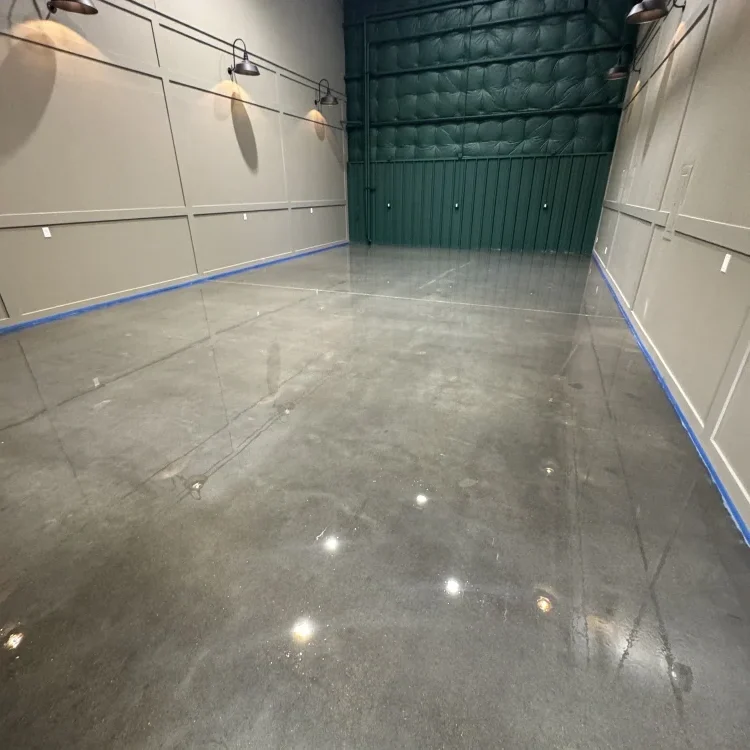
Color that soaks into the slab
A stained floor starts as plain gray concrete and ends as the same concrete with color living in its top layer. Acid stain reacts with the lime in the cement and leaves mottled earth tones behind. Water-based stain carries pigment down into the open pores and gives you a wider color range with fewer surprises. Neither one builds a film you could peel up with a fingernail, which is why stain suits rooms where a thick, glossy coating would look out of place.
That also means stain hides nothing. Patched spots, old carpet glue, a paint drip, a tire mark: the stain finds every one of them and puts it on display. So the work begins with a grinder, opening the surface and taking off curing compound and old sealer that would block absorption. Skip the grind and you get blotches that look like a mistake instead of character. On a coating job a bad grind at least gets buried. On stain there is nothing on top to bury it under, so the prep shows for the life of the floor.
The test area comes before the rest of the floor
Put the same bottle of acid stain on two Kemah slabs and you will get two different floors. Mineral content, the age of the pour, how hard it was troweled and how much water it is holding all change how the color develops. Water-based stain behaves more predictably, though even it takes a little differently from one slab to the next. That is why we never pick a color off a chart and roll it across your whole patio on faith.
- We grind a small area somewhere out of the way, usually a corner
- The stain you are considering goes on, reacts, and gets rinsed
- We seal the test so you see the color wet, the way it will actually live
- You approve it, or we try the next option before anything else is touched
Acid stain in particular shifts between dry and sealed, so judging a dry test is how people end up disappointed. Look at it sealed, in the light that room really gets in the afternoon.
What bay-side moisture does to a stain job
Kemah sits on clay subsoil, and near the bay that clay hangs on to groundwater longer than ground farther inland. A slab poured on it can feel dry on top while it keeps pushing moisture up from below. For an epoxy coating, that vapor is an adhesion problem. For stain it shows up in a different way: damp concrete takes color unevenly, acid stain can react weakly or go splotchy, and a sealer laid over a wet slab can cloud or lift. So every Kemah slab gets a calcium-chloride moisture test before we talk color at all. The number tells us whether the slab is ready for stain or needs more time and a different plan. We would rather say that to you on day one than seal a problem in and hand you the bill for it later.
Want to see your own slab with color on it?
We come out to test the slab for moisture and lay down a stain sample where you can judge it in person.
The sealer takes the sun so the color doesn’t have to
Stain itself is tough. Acid stain becomes part of the concrete, and a good water-based stain locks into the pores. What wears is the sealer on top, and near the bay that sealer works hard. Direct Gulf sun beats on any patio edge that isn’t fully shaded. Salt air settles on every surface close to the water. If a pool sits nearby, chlorine splash lands on the slab too. An interior-grade sealer yellows and goes chalky under that kind of load, and then the color underneath looks tired even though it hasn’t gone anywhere.
We seal Kemah stain jobs with UV-stable chemistry and choose the sheen for the space, from a low matte on a covered patio to more gloss indoors. Day to day, upkeep is a dust mop plus a damp mop with a pH-neutral cleaner. When water stops beading the way it used to, the sealer is telling you it has worn thin, and a reseal brings it back without touching the color below. That reseal is the real maintenance on a stained floor, and it is light work next to stripping and recoating a painted slab.
Covered patios and the back of the house
Most of the stain work around the bay lands in two kinds of space. One is the covered patio on a waterfront home, on the bay side or along NASA Parkway, where people want a floor that looks like it belongs outdoors without the busy texture of a flake system. Stain gives that soft, uneven tone, and with the right sealer it stands up to bare feet and a hose-down after a long weekend outside.
The other is commercial: back-of-house floors in Kemah Boardwalk restaurants and the service areas behind the tenant mix along 146. Stain earns its keep there when the room needs a durable, cleanable surface that doesn’t draw the eye. Where a kitchen line sees heavy grease and harsh cleaning chemistry, we will tell you plainly that a chemical-rated coating is the better call and point you toward our Kemah solid color epoxy work instead. If you want to look at finished floors before you decide anything, the project gallery has plenty of them.
What Kemah owners ask before we stain
Can you stain over a slab that already has a coating on it?
Not directly. Stain needs open, bare concrete to soak into, so any old epoxy, paint or sealer has to come off first. We grind it away and look at what is underneath. Sometimes the bare slab is a great candidate. Sometimes years under a coating leave it patchy enough that we suggest a different finish.
Will the stain color fade on an uncovered patio?
The stain itself holds well. What fails first is the protection over it, so on an uncovered Kemah patio the UV-stable sealer does the heavy lifting. Keep that sealer in good shape and the color stays put. Let it wear through in full Gulf sun and the surface starts to look dull and dry.
Does stained concrete get slippery when it is wet?
A glossy sealer on smooth concrete can get slick, especially near a pool or an outdoor kitchen. We can mix a fine grit into the final sealer coat so the floor keeps some grip when it is wet. Covered patios that stay dry usually do fine with a low-sheen sealer and no grit at all.
Can you stain part of a floor and leave the rest gray?
Yes. A stained border or a stained field inside a plain gray frame are both doable. We tape and mask the edges so the color stops where it should. Keep in mind that the bare gray concrete beside the stain still needs sealing, or it will soak up spills and end up looking worse than the stained part.
Is a moisture test really needed on a covered patio?
Yes, every time. A roof keeps rain off the surface but does nothing about groundwater coming up through the clay underneath. Bay-adjacent slabs in Kemah can hold moisture long after the top looks dry. The calcium-chloride test takes the guessing out of it before any color goes down on your slab.
What colors can I choose from?
Acid stain stays in the earth-tone family, mostly browns, tans, rusty reds and greens. Water-based stain opens up grays, blues and stronger custom shades. Your slab still has the final say on how any of them turn out, which is why we decide from a sealed test area on your own concrete and never from a printed chart.
Can stain hide the cracks in my patio?
Not really, and we won’t pretend it can. Hairline cracks usually stay visible and blend into the mottled look. Wider cracks get filled before staining, and the filler takes color a little differently than the concrete around it. We stain a repaired spot first so you know exactly what to expect across the floor.
The rest of our Kemah lineup
Every one of these jobs starts with the same moisture test. You can see everything we do around the bay on the Kemah, TX page, read how we approach stained concrete across the region, or set up a quote and we’ll come take a look at the slab.
Set up a stain quote for your Kemah slab.
Tell us where the slab is and what you want it to look like. Justin or someone from the crew will call you back.
- Moisture test before any color talk
- Sealed test area on your own concrete
- Straight answers about your slab
Prefer to talk? Call (346) 624-0125
From the Friendswood shop to the bay
Kemah is about 30 minutes east of our Friendswood shop, and Seabrook and League City sit 5 to 10 minutes up the road from it, so a stain job here gets the same crew that handles the rest of the bay.