Laying Out a Patterned Floor Around Columns, Doors and Thresholds
A patterned floor gets decided on paper before any coating is mixed. We lay the grid out from the columns, doors and thresholds people actually look at, so the lines land square there and the cut pieces fall where furniture hides them. You see a sample before anything is committed, and colors get picked in the light the patio really has.
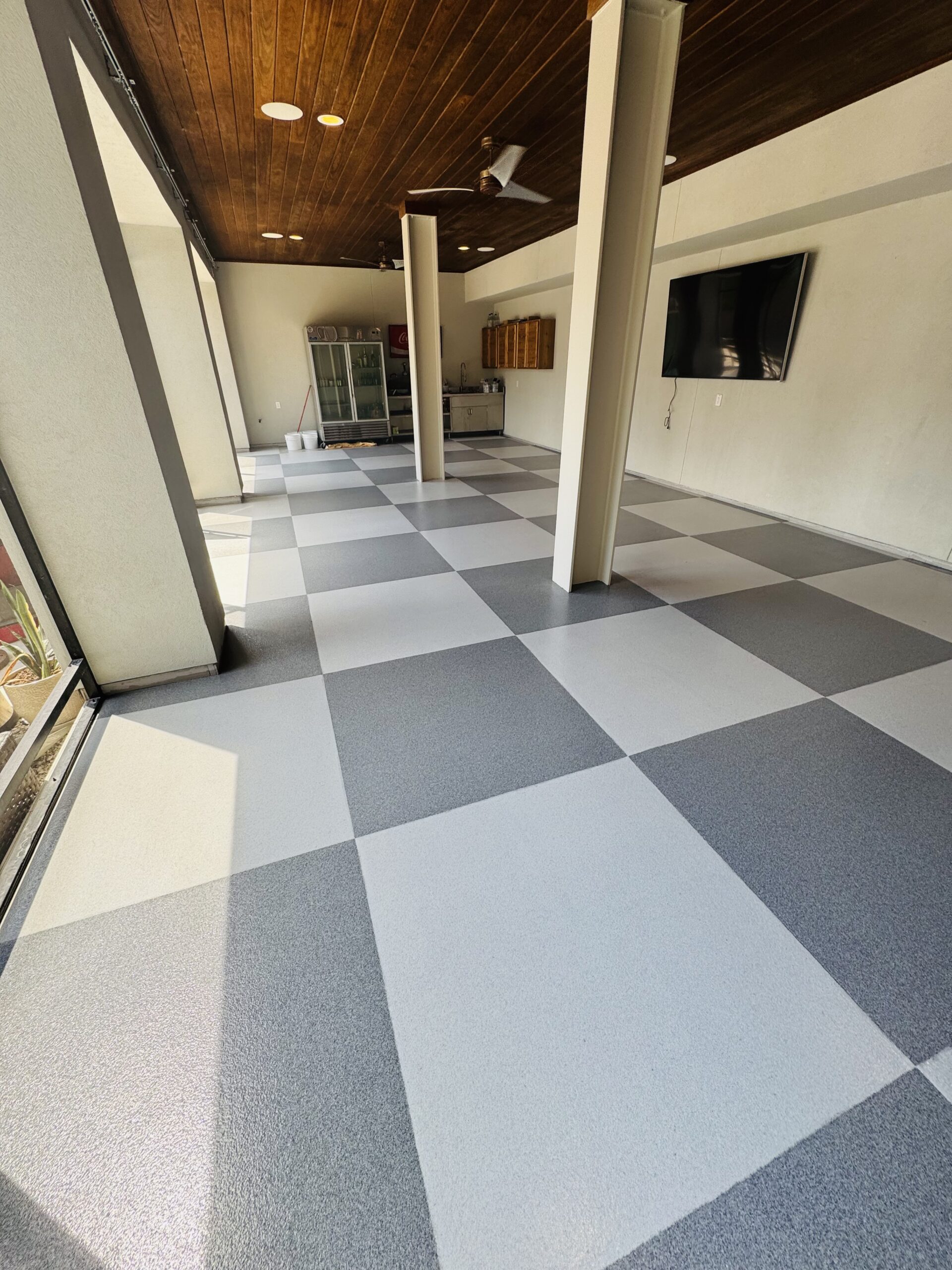
The checkerboard floors people send us screenshots of all share one thing, and it is not the colors. The lines run straight to the columns. The squares are whole at the door. Nothing is trimmed down to a sliver along a wall. That is layout, and it happens with a tape measure and a chalk line long before a drop of coating touches the slab. Get it wrong and a pattern that looked sharp on a phone looks crooked in person every single day after.
Where the First Line Goes Decides Everything
Every patterned floor has a starting line, and most bad ones started in a corner. Corners are almost never square. Walls drift. Slabs get poured a little out of true. Start a grid from a corner and the error builds across the room until the last row of squares is visibly tapered.
We start from whatever the eye lands on first. On a covered patio that is usually the main door out of the house, or the center line between two columns. In a restaurant it might be the entry or the front of the bar. We snap that line, work outward from it, and let the cut pieces fall at the edges where planters, furniture and cabinets will cover them.
We also size the pattern to the room instead of picking a square and hoping for the best. If one grid size leaves a three-inch strip along the back wall, we change the grid. An odd square size nobody will ever measure looks far better than a skinny row everybody notices the moment they walk out.
Columns Are the Hard Part
Columns break a pattern in the middle of the floor, where nothing can hide under a sofa. A grid that ignores them ends up with a post sitting off-center in a square, or a seam running into the side of a column at an angle. Either way it looks like nobody gave it any thought.
So the columns get measured before anything else. Where they are evenly spaced, we fit the grid so each one lands on a line or sits centered in a square. Where they are not, which happens more often than people expect, we pick the row that matters most from the house and favor that one.
Around the base of each column the work slows way down. Tape lines have to wrap the post cleanly, and both colors need a crisp edge where they meet it. That is hand work. It is the part you would never notice in a time-lapse video and the part you look at every time you step outside with a cup of coffee.
A Sample Before Anyone Commits
Color chips on a card are misleading. They are small and flat, and they usually get looked at indoors. A floor is big and slightly textured, and it is seen in whatever light the room has.
Before a decorative job is locked in, we put a sample in front of you. Sometimes that is a board with the actual colors and finish side by side. On larger or fussier jobs it can be a mockup on the slab itself, in a spot that will be covered later, so you can see how the two colors sit together at full size.
This is where most decisions change. People set on a stark dark and light often go softer once they see the contrast across a whole patio. Others find the gray they loved reads blue against their brick or their cabinets. Better to learn that from a sample than from a finished floor. We also tape the pattern out on the slab so you can stand on it and judge the scale with your own feet.
Two Colors or One Field
Not every room wants a pattern. A busy outdoor kitchen, a narrow walkway or a small entry can look cluttered under a checkerboard, and a single field color with a broadcast finish often reads cleaner in those spaces.
Patterns earn their place on open floors where people stand back and take in the whole thing: a covered patio, an event room, a restaurant dining area. Feature floors for Kemah Boardwalk restaurants and for the tenant mix along 146 are good examples. A two-tone band at the entry or a border around the dining floor gives a business some identity without turning every square foot into a statement.
Scoring is the quieter option. Lines cut into the slab and then colored or sealed give you a grid or border without two contrasting fields. It suits owners who want some structure underfoot but nothing loud. The options are laid out on our decorative concrete page for Kemah, along with how we handle the edges where two treatments meet.
Sun at the Open Edge of a Covered Patio
A covered patio is never one light condition. Under the roof near the house, the floor sits in shade most of the day. Out by the open edge, low afternoon sun crosses it and the bay light brightens everything. The same two colors look different at each end.
That changes the color call. Dark colors near the open side get hot underfoot and show every bit of dust and pollen. Bright whites can glare in late sun. We usually steer toward a pair that holds up at both ends of the patio, and we look at the sample at the time of day you actually use the space, which for most people is evening.
The topcoat matters just as much as the colors. Whatever pattern goes down gets a UV-stable sealer, because the open edge takes direct Gulf sun and an ordinary clear coat ambers over time. On a two-color floor that yellowing hits the lighter squares first, and it shows along the sunny edge instead of evenly.
What Owners Ask About Patterned Floors
How big should the squares be on a checkerboard patio?
Big enough to look intentional at the size of the room, and sized so the grid fits the space instead of the other way around. We measure the columns, doors and walls first, then pick a square size that keeps cut pieces at the edges and full squares where people look. Every patio comes out a little different.
Can a pattern go over an old patio slab with cracks in it?
Yes, once the cracks are repaired. A pattern is unforgiving about a crack because the line jumps wherever the slab moved. We fill and level the damage first, then lay out the grid so a repaired joint lands on a seam where possible. A crack running diagonally through the middle of a square is what we work hardest to avoid.
Does a two-color floor take more work than a single color?
It does. Each color has to be masked, applied and allowed to set before the next one goes down, and the tape lines around columns and doors are done by hand. That means more visits and more care than a one-color floor. We lay the schedule out at the quote visit so nobody is surprised.
Get the pattern drawn before anything gets mixed
Send a photo of the space and point out the columns or doors that matter most. We measure it, lay out the grid and set up a quote in writing.
Finish My Floor Call Justin (346) 624-0125Finished patterned floors are in the gallery, or tell us about your patio and we will come walk it with a tape measure.