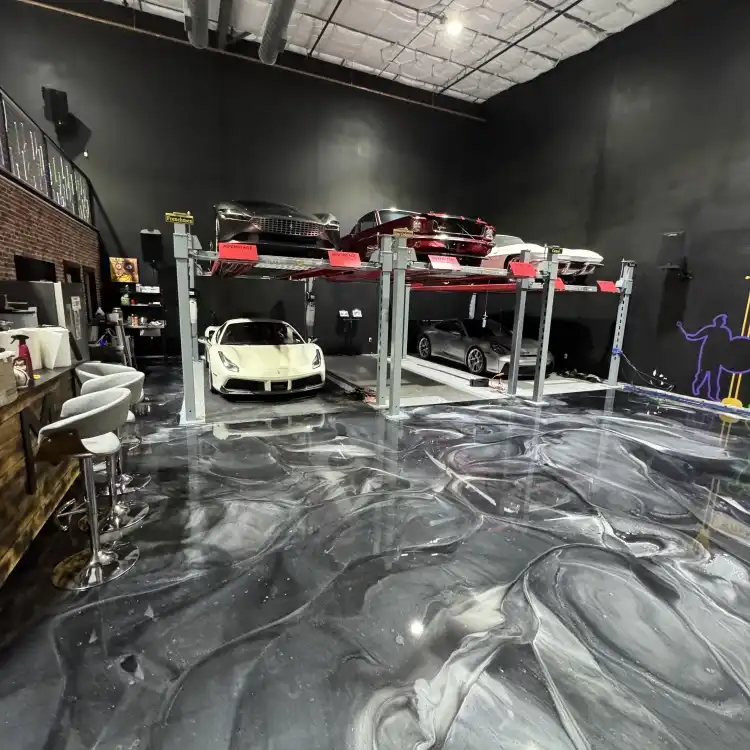
League City commercial coatings need application-matched specs. Restaurant kitchens need NSF/FDA-compliant epoxy. Retail and showrooms need durable polyaspartic-flake for traffic. Gyms need shock-absorbing thick builds. Light industrial along NASA Road 1 needs 80+ mil systems for forklifts. After-hours and phased installs minimize disruption.
Restaurant Kitchen Floors
League City restaurants need FDA-compliant epoxy meeting NSF standards. Kitchen floors handle hot oil splash, high-heat cleaning chemistry, daily power-washing, and constant foot traffic. Standard spec: 100 percent solids epoxy primer, color base coat, polyaspartic topcoat with anti-slip aluminum-oxide grit.
Cove base detail at floor-to-wall transitions prevents mold and water infiltration, required by health codes in League City and Galveston County. We coordinate cove detail with the GC during construction or pre-existing modifications. Restaurant kitchen builds are priced per square foot by the spec.
Why Integral Coving Is the Part Owners Skip
The joint where your kitchen floor meets the wall is the first thing that fails, and it is the first thing an inspector looks at. A square corner holds water. It holds grease. Mop water runs into that seam every single night, sits there, and works its way behind the base tile or under the wall board. A year later somebody smells it before they see it.
Integral coving fixes that by running the floor coating up the wall in a radius instead of stopping at a hard corner. There is no seam to fail because the cove and the floor are the same material, installed at the same time, cured as one piece. A mop or a squeegee rides right up the curve and pushes water back out to the drain instead of packing it into a crack.
Height depends on how the space gets cleaned. Four inches is common in a dry prep area. Six inches is a better call anywhere hoses come out. Along a dish pit or a wash-down wall we go higher, because a pressure hose will find anything you left short. Coving is fussy work and it takes a day the schedule has to account for, which is why it gets value-engineered out of budget builds and why those same builds are patching the base of the wall two years in. If your kitchen is getting a coating, cove it.
Slip Rating Is a Staff Safety Number, Not a Marketing Number
Every commercial coating salesperson says the floor is slip-resistant. That word by itself means nothing. What matters is how much grit is broadcast into the topcoat, how coarse that grit is, and whether the number holds when the floor is wet and greasy instead of clean and dry in a showroom. A kitchen floor is basically never dry. Spec the texture for the worst condition, not the best one.
The trade-off is real and I will tell you about it up front. More aggressive grit means better footing and a harder floor to clean, because the same texture that grabs a shoe also grabs grease. Less grit cleans faster and gets slick sooner. Most kitchens land in the middle, with a heavier broadcast along the line, at the fryer station, and in the dish pit, and a lighter one in dry storage and walk-in approaches where nobody is standing in water all shift.
We do sample panels for this and I would rather you walk on one in a sock and a work shoe before we coat 3,000 square feet. Your crew is on that floor eight to twelve hours a day carrying hot pans. A slip in a kitchen is not a scuffed floor, it is a burn and a workers comp claim. Pick the texture that keeps them upright and plan the cleaning around it.
Grease, Hot Oil, and Thermal Shock
Three things kill kitchen floors. Grease works into anything porous and never comes out. Hot oil from a fryer boil-over hits the floor at a temperature no consumer-grade coating was built for. And thermal shock happens every night when someone runs near-boiling wash-down water across a slab that has been sitting at room temperature.
Thermal shock is the one people miss. Concrete and coating expand at different rates. Dump 180-degree water on a cold slab and the coating wants to move faster than the concrete under it. Do that every night for a year on a thin or poorly bonded system and it starts letting go at the edges, usually near the drains where the water hits first and hottest. That is not a product defect, that is a spec that was too thin for how the room actually gets cleaned.
The fix is thickness and bond. A properly ground and profiled slab, a primer that soaks into open concrete instead of sitting on a slick surface, and enough mils of build to absorb the movement. Novolac epoxy goes in where the chemical and heat load is heaviest, like directly around fryers and under cook lines. It costs more per square foot than a standard build, and in those specific zones it is worth it. Everywhere else in the kitchen, a standard solids epoxy with the right topcoat holds fine.
Drains, Slopes, and the Transitions Nobody Plans For
Water has to go somewhere. In a kitchen that means trench drains and floor sinks, and the coating has to meet them cleanly or you have built a leak. We terminate into a keyed edge cut at the drain so the coating locks into the concrete instead of feathering out to a thin lip that chips off the first time a rack rolls over it.
Slope is the other half. A lot of older League City kitchen slabs were poured flat or have settled out of pitch, so water stands in low spots no matter how well the drain works. Standing water on a kitchen floor is a health inspection problem and a slip problem at the same time. If we find birdbaths during the walkthrough we can build the slope back with a mortar or a slurry fill before the coating goes down. That is extra work and extra time and it belongs on the quote in writing, not as a surprise on day two.
Transitions to other rooms matter too. Where the kitchen meets carpet, quarry tile, or a walk-in cooler floor, the coating needs a defined stop with a saw-cut termination. A coating that just runs out to a thin edge at a doorway gets peeled up by hand truck wheels within months.
What a Health Inspector Actually Sees
An inspector is not grading the color. They are looking for surfaces that can be cleaned and that stay cleanable. A porous or failing floor fails on that test in obvious ways: cracks that hold food debris, chipped spots at drains and doorways, a base that has separated from the wall, standing water, and grout lines in old quarry tile that have gone soft and dark.
That is the real argument for coating a kitchen over patching one. A monolithic coated floor with proper coving has no grout lines and no seams to score against. It cleans with a deck brush and a squeegee. When something goes wrong, it goes wrong visibly and in one spot, and it gets repaired in one spot instead of turning into a full replacement conversation with a deadline attached from the county.
Keep your paperwork too. We hand over the system spec, the product data sheets, and dated photos of the prep and each coat. If an inspector or an insurance adjuster ever asks what is on that floor and whether it meets the standard, you have the answer in a folder instead of trying to remember who did the work.
Retail and Restaurant Front-of-House
Retail floors and restaurant front-of-house need durable, easy-clean, traffic-rated systems. Standard spec: flake epoxy with polyaspartic topcoat. Color choice usually neutral (gray, beige, brown) to not compete with merchandise or food presentation.
Retail floors at League City strip malls and the area around the Mall of the Mainland get heavy weekend traffic. Polyaspartic topcoats handle the wear without showing scratches. Refresh-topcoat at 10 to 15 years extends life. Retail floors are the entry tier per square foot.
How Retail Floors Actually Wear
Retail wear is not even, and once you know the pattern you can spec around it. Traffic funnels. It comes in the front door, turns toward the register, and cuts the same corners at the end of every aisle. Walk any store that has been open five years and you can see the path worn into the floor. That is where the topcoat goes first, and it is where a cheap system starts looking tired while the rest of the floor still looks new.
The entry zone is the worst of it. Everything the parking lot has gets tracked in on shoe soles: sand, grit, road salt film off the Gulf Freeway, and after any rain, a fine mud. Grit under a shoe is sandpaper. A walk-off mat inside the door does more for a retail floor than another mil of coating, and we say so during the walkthrough. Where the budget allows, we run a heavier topcoat build across the first fifteen or twenty feet inside the door and taper back to standard past that.
Carts are the other one. Hard plastic and steel cart wheels concentrate weight on a small contact patch and they drag grit along with them. Same with pallet jacks in a stockroom that shares a floor with the sales floor. And point loads add up fast: display fixture legs, gondola feet, and chair legs in a dining room all press down through a footprint the size of a quarter. A floor that shrugs off foot traffic can still get dimpled by a heavy fixture sitting in one place for two years. If you know where the fixtures land, tell us before we spec, because that changes the build thickness under those runs.
Light, Color, and What a Coated Floor Does to a Room
People think of a floor coating as a durability decision and then get surprised by what it does to the room. A coated floor has a reflectance value the old slab or the old tile did not, and that changes how the whole space reads under your existing lights.
Go light and glossy and the room brightens considerably, because the floor bounces your overhead lighting back up instead of eating it. In a showroom or a boutique that can be the difference between needing more fixtures and not. Go dark and glossy and you get depth and a high-end look, but you also see every footprint and every bit of lint, and dark floors in a bright storefront can throw glare right at eye level depending on where your windows face. A satin topcoat is the middle ground most retail clients land on. It still cleans up bright and it hides day-to-day traffic dust far better than a full gloss.
Do the color choice in the actual space, under the actual lights, at the hour you are usually busy. A chip that looks perfect in a truck bed at noon looks different under 4000K LEDs at 7pm. We leave sample boards on site so you can live with them for a few days before we order material. Nobody should be picking a floor color from a phone screen.
Showroom Floors: Auto Dealerships and Jewelry
League City auto dealerships along the Gulf Freeway and high-end retail benefit from metallic epoxy floors. Pearl pigments create depth that draws eyes to merchandise. The cost premium per square foot is justified by visual impact.
Cool-tone metallics (silver-on-graphite, blue-on-charcoal) work for modern showrooms. Warm-tone metallics (copper-on-bronze, gold-on-walnut) work for traditional and luxury retail. Sample boards always shown.
Gym Floors and Light Industrial
Gym floors handle dropped weights, treadmill vibration, and constant traffic. Standard 25-mil flake epoxy isn't enough; gym-grade systems run 50 to 80 mils with shock-absorbing underlayment in free-weight zones. Gym floors are priced per square foot by the mil thickness and underlayment.
Light industrial along NASA Road 1 and the Texas City corridor handles forklift traffic, pallet jacks, and chemical exposure. High-mil systems (80 to 120 mils) with abrasion-rated topcoats are standard. Light industrial floors top the commercial range per square foot. Lifespan 15 to 25 years with appropriate maintenance.
Installing Around a Business That Is Still Open
Most commercial floors we do are in rooms that are making money. Nobody wants to close for a week. So the schedule is a real part of the job and it gets worked out before anyone touches a grinder.
Overnight is the common answer for restaurants. We come in after close, grind, coat, and are out before the morning prep crew shows up. That works when the system cures fast enough to take foot traffic by open. Retail usually runs the opposite way, weekend nights or a Sunday through Monday window when the store is shut anyway. Either one costs more in labor than a normal weekday install, and I quote both ways so you can see the difference and decide.
Phasing is the other tool. On a bigger space we rope off a section, coat it, let it cure, move the fixtures or the equipment over, and take the next section. The floor ends up with cold joints between phases, which we plan into the layout so they land at a natural break like a doorway or a fixture line instead of down the middle of an open sales floor. Phasing takes longer overall and it means more mobilizations, but the doors stay open the whole time.
Cure Windows Drive the Whole Plan
This is the part that surprises people. There is not one cure time, there are three, and they matter at different points.
First is tack-free, when the surface stops being sticky. Second is foot traffic, when your crew can walk on it in clean shoes without leaving prints. Third is full chemical and load cure, when you can roll a rack across it, set heavy equipment back down, or hit it with hot wash-down water without hurting anything. That last one is usually days out, not hours, and it is the one that gets ignored. Roll a loaded 400-pound rack onto a floor that is walkable but not load-cured and you will press wheel tracks into it permanently.
Which is exactly why the calendar picks the system as much as the look does. If you have a hard opening on Monday morning, a standard epoxy build with a long cure is off the table no matter how much you like it, and we go to a fast-cure polyaspartic that can be returned to service inside the window you have. If you have a full weekend and no pressure, a slower system opens up more finish options and usually costs less. Tell me the real deadline first. I would rather design the spec around your calendar than promise a finish and then rush the cure, because a rushed cure is how a floor fails in month four.
What We Find Under Older League City Slabs
Very few commercial spaces around here are bare concrete. Most have had something on them. Tile that came up and left mastic. VCT and its adhesive. An old sealer. Sometimes a previous coating that is already lifting in spots, which tells you it never bonded right the first time.
All of that has to come off, mechanically, down to open concrete. We grind, and where the mastic is heavy we shot blast. That is the loud, dusty, unglamorous part of the job and it is most of the labor. It is also the whole ballgame, because a coating is only as good as its bond to the slab, and a slab with cutback adhesive smeared into the pores is not going to hold anything. If we walk a space and find three layers of history on the floor, the prep line on the quote goes up. I would rather show you that number honestly than bid it low and then find a reason to change the scope once the equipment is in the building.
Moisture is the other thing we test for before we quote anything, not after. Older slabs frequently have no vapor barrier under them, and Gulf Coast ground stays wet. Moisture pushing up through concrete will lift a coating off the slab in sheets and it does not care how good the product is. We run calcium chloride or relative humidity probes and let them sit the required time. If the readings come back high, the fix is a moisture-mitigating primer under the system. That is a real line item and it belongs in the written scope up front.
Gumbo Clay, Joints, and Gulf Humidity
The clay under this part of Texas moves. It swells when it rains and shrinks in a dry August, and the slab sitting on it moves with it. That movement shows up as cracks and as joints that open and close through the year. Anyone who tells you a coating will stop that is selling you something. A coating is a few millimeters thick and it is not going to overpower a soil that lifts a foundation.
What you do instead is treat the joints honestly. Static cracks get chased out, filled with a rigid polymer, and coated over, and those hold fine. Moving control joints get a semi-rigid joint filler that flexes a little, and we keep the joint honored through the coating rather than burying it. If you coat straight over a live joint, the concrete moves and the coating tears in a jagged line that looks worse than the joint ever did. Honoring it means the joint stays a clean straight line you can see, and it can be recaulked later without touching the rest of the floor.
Humidity affects the install itself. Polyaspartics and polyureas cure by reacting with moisture in the air, so a muggy August afternoon in League City makes them set up noticeably faster than the data sheet suggests. That shortens working time and it is a real risk of lap marks if the crew is not moving. We adjust the catalyst and the batch sizes for the conditions on the day rather than mixing to a fixed recipe. Dew point matters too. If the slab is colder than the dew point, condensation forms on the surface while you are coating it and the bond suffers, which is a live problem in a walk-in-adjacent space or an unconditioned stockroom in the winter. We check surface temperature before we start, and if the numbers are wrong we say so and move the day.
Working with League City Property Managers
Documentation matters: certificates of insurance (full general liability coverage), workers comp, signed warranties, dated photographs of prep and install, single-point-of-contact for service. We provide all of it.
Multi-tenant buildings need coordination with neighboring tenants on HVAC, access, and noise. We handle that directly. Permits pulled where needed (City of League City and Galveston County). Project management on schedules with weekly milestone reports for multi-week projects.
League City Concrete Coatings FAQ
After-hours pricing?
After-hours installs add 10 to 25 percent labor premium. We quote both standard and after-hours options when relevant.
NSF and FDA compliance?
Yes. Restaurant kitchen floors meet NSF and FDA cleaning standards with proper polyaspartic topcoats. Cove base detail required by health codes.
Phased installs?
Yes. Half-floor or section-by-section installs on bigger spaces. Keeps the business operating throughout.
Hurricane season scheduling?
We don't install during active warnings or 48 hours after a system passes. Otherwise Gulf Coast weather doesn't affect routine commercial installs.
Maintenance contracts?
Yes. Annual inspection and refresh contracts available. Worth it on commercial high-traffic floors.
How long before we can use the floor again?
Three different windows. Foot traffic usually comes back first, then rolling loads, then hot wash-down and chemical exposure last. That final one is days out on most systems. Tell us your reopening deadline at the walkthrough and we pick a system that fits it instead of rushing a cure.
Do we have to remove old tile or mastic first?
It has to come off, and that is our work, not yours. We grind or shot blast down to open concrete. Old adhesive left in the pores is the most common reason a coating lets go later. Heavy removal adds prep time, and it shows on the written quote before we start.
What is coving and does our kitchen need it?
Coving runs the coating up the wall in a radius so there is no seam at the floor-to-wall joint to trap water and grease. If your kitchen gets hosed or mopped down nightly, yes. It is the first place an uncoved floor fails and the first place an inspector looks.
Do you test for moisture before quoting?
Yes, on any older slab. Plenty of commercial buildings here were poured without a vapor barrier and Gulf Coast ground stays wet. If the readings are high we add a moisture-mitigating primer, and that goes in the written scope up front rather than turning up as a change later.
Need League City Commercial Epoxy?
10+ years of combined crew experience in concrete coatings across League City and the Houston area.
Finish My Floor (346) 624-0125Read our full League City Commercial Epoxy page · More posts · Ask Justin for a price