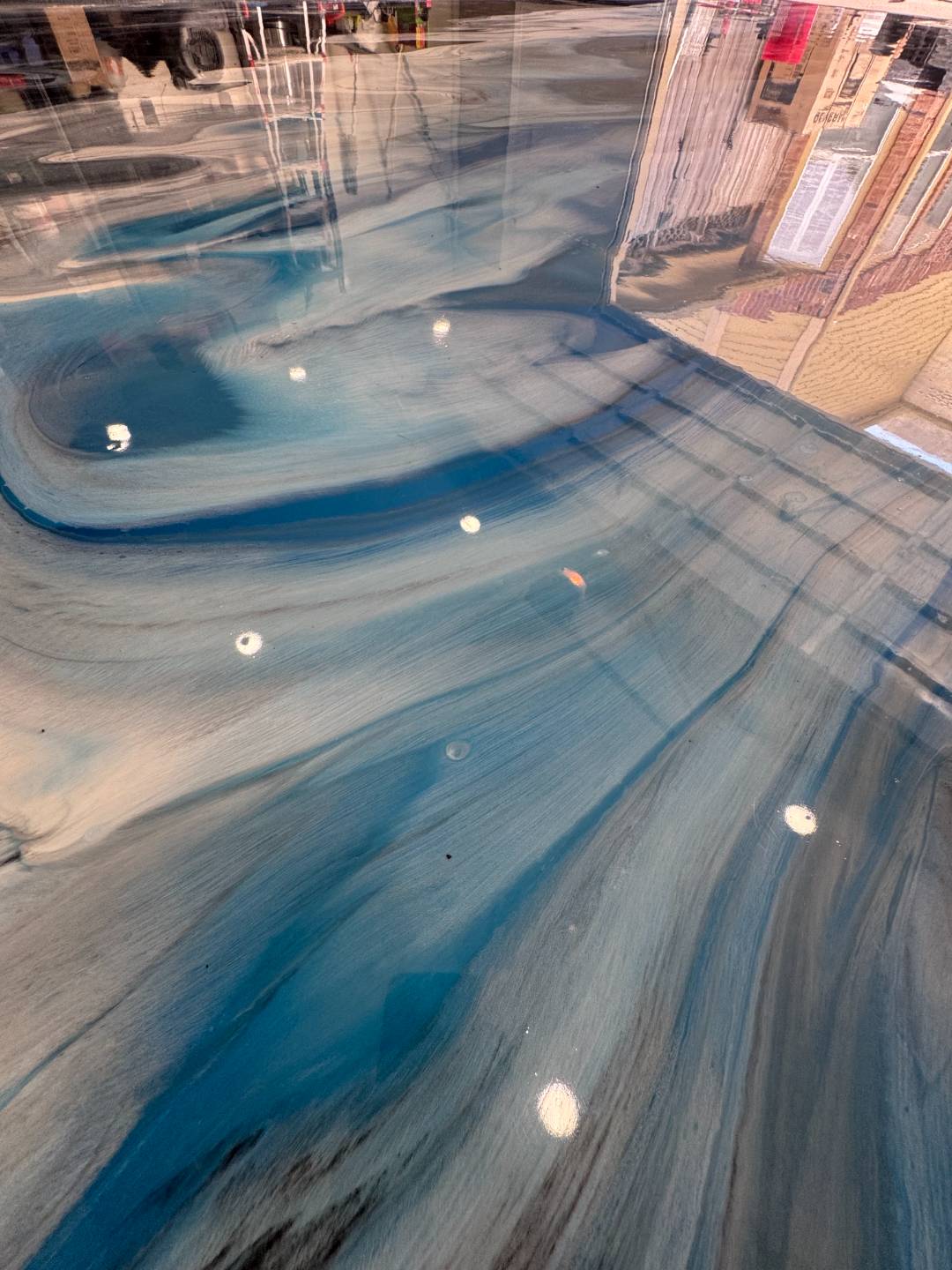
A suite in The Woodlands has usually carried three or four tenants before you, and the slab keeps a record of all of them. Tile mastic, cutback, thinset, patch compound and carpet glue each come off a different way. Removal and prep drive the calendar far more than the coating does, and a moisture reading only tells the truth once the old covering is gone.
The Slab Keeps a Record
You sign a lease on a suite off Town Center or in one of the Market Street buildings, you walk it with the landlord, and what you see is whatever the last tenant left. Vinyl plank. Broadloom carpet. Twelve inch tile with a soft grout line. What is underneath is the part that decides your schedule.
Peel a corner up in a space that has turned over three times and you can read the building’s history in layers. Black cutback from the original tile. A skim of thinset where somebody set porcelain in the entry. Self levelling compound poured to bury a bad spot. Yellow carpet glue over the top of it, still tacky twenty years later. Every layer is in the way of a bond, and every one of them removes differently.
Five Adhesives, Five Different Removals
Carpet glue is soft. It loads a grinding wheel and turns to gum, so it wants different tooling than anything hard. Cutback is the opposite problem: it smears under heat, works into the pores, and it is the layer most likely to come back through a coating months later if somebody rushed it. Thinset is hard and takes real aggression, usually a coarse metal bond segment or a shot blaster. Self levelling compound is its own conversation, since sometimes it is sound enough to grind and coat and sometimes it is chalky and has to leave.
So the honest answer to how long removal takes is that it depends on what the last four tenants did, and nobody knows that from a walkthrough with the flooring still down. We cut test patches. Two or three small openings tell us what tooling to bring and how many passes it takes.
Prep Sets the Calendar, the Coating Does Not
This is the single most common scheduling surprise on a turnover, and I want to be plain about it. The coating goes down fast. Prep is where the days live.
On a bare slab a crew can grind, prime and put a system down quickly. On a suite with four layers of history, demolition and grinding are most of the labor and most of the calendar. When someone quotes a fast turnaround before anyone has opened the floor, they are quoting the coating and hoping the prep is easy. Our commercial epoxy work in The Woodlands keeps removal broken out as its own line so you can see where the days are going.
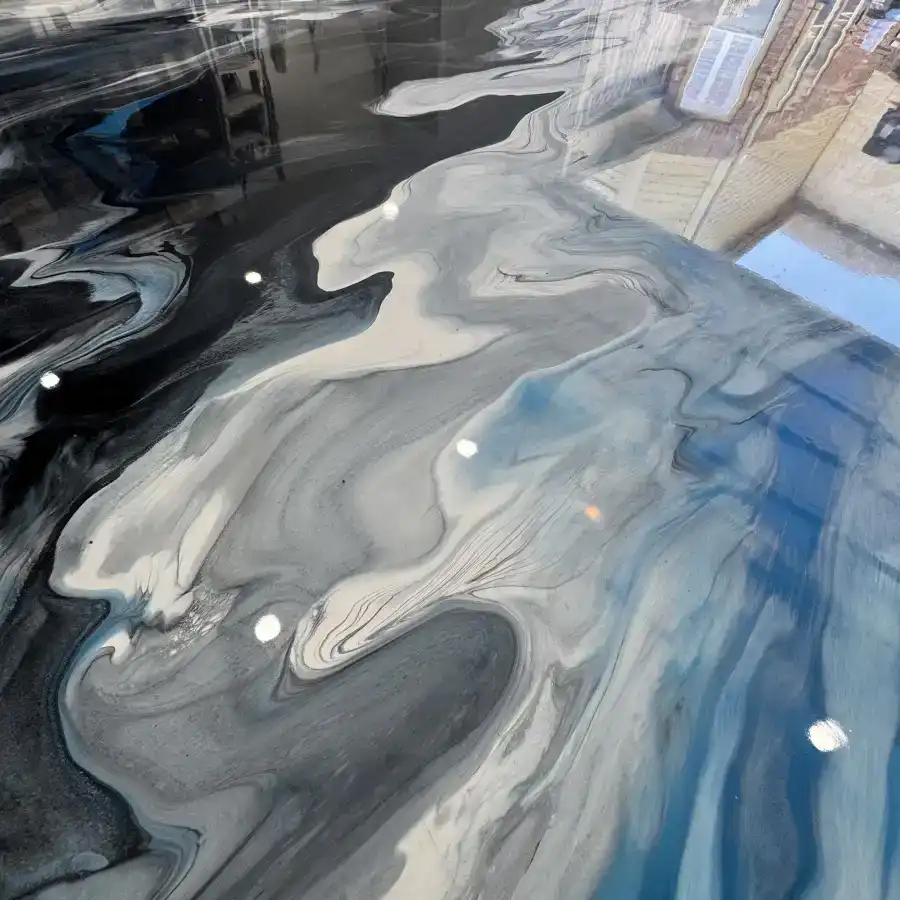
The Slab Reads Wet Once It Can Breathe
Here is the one that catches people. A slab sealed under sheet vinyl or glued down plank for fifteen years has had nowhere to send its moisture. Pull the covering off, the concrete finally opens up, and the reading comes back high. Nothing changed in the ground. You just uncovered what was always there.
On the Gulf Coast that is the rule rather than the exception. Plenty of slabs in Montgomery County went in with a thin vapor barrier or none at all, and the ground here stays damp most of the year. Moisture pushing up through concrete will lift a coating off in sheets no matter how good the product is.
Which is why the reading has to happen after the covering comes off and after the slab has had a few days to settle. A test through old vinyl tells you nothing. We set relative humidity probes or calcium chloride and let them run their full time. If the numbers come back high, the answer is a moisture mitigating primer under the system, and that goes in the written scope before we order anything.
Flat, Level, and the Trench Somebody Patched
Second slab surprise: the floor is not flat. Suites that have held a restaurant, a salon or a dental office usually had plumbing cut into the slab at some point, and that trench got patched by whoever was cheapest that week. You end up with a ribbon of newer concrete running across the space, a little proud or a little low, sometimes a different color entirely.
Under carpet nobody notices. Under a gloss coating everybody does, because a reflective floor shows every ripple the way still water shows wind. Grinding flat takes the high side down and blends the transitions, which works when the difference is small and the patch is sound. An overlay is a self levelling pour across the whole floor that gives you one new flat surface, which costs more time and material and is the right call when the slab is genuinely out of plane. Make that call with a straightedge and the lights on, before anyone picks a finish.
Suites in the Medical Corridor
The offices around the hospital district have a different priority list. Nobody there is asking about metallic swirl. They want to know whether the floor cleans and what happens where the floor meets the wall.
A coated slab gives that room no grout lines to score, no seams to hold anything, and a coved base where the floor turns up the wall in a radius so a mop pushes water out instead of packing it into a corner. Light color reads clean under exam lighting. A tight, low profile texture keeps footing without giving debris somewhere to sit. Those are properties of the system. The facilities manager or the practice’s own people decide what their standard requires, and we build to the spec they hand us and document what went down.
Back of House Along the Waterway
Restaurant turnovers along the Waterway and around Market Street bring the drains into it. A back of house slab is sloped toward trench drains or floor sinks, and that slope has to survive the prep. Grind a sloped floor carelessly and you flatten the fall, and water stands where it used to run.
The coating also has to terminate into the drain properly. We key an edge cut so the system locks into the concrete instead of feathering out to a thin lip that a rack wheel chips off in month one. Texture goes heavier where the water and grease live, at the dish pit and the cook line, and lighter in dry storage. Montgomery County health inspectors will have their own read on the finished space, so your operator should walk the plan with them before we start.
Dust, Noise, and the Neighbors Who Are Open
Your suite may be dark. The ones on either side are selling coffee and cutting hair. Grinding and shot blasting are loud and dusty, and both travel through a demising wall and a shared return.
Containment is real work and it belongs on the schedule. We poly off openings, seal the bottom of the demising wall where the gap always is, run vacuums on the grinders, and put negative air on the space so loose dust comes toward us rather than the shop next door. Shared HVAC gets isolated for the loud days, which is a conversation with the property manager ahead of time. Most centers here already have a noise window written into their rules, usually earlier than tenants expect.
Sequencing Around the GC and the Lease Clock
On a build out we are one trade among several, and floors sit near the end of a chain we do not control. Overhead work has to be finished, because nobody wants a ceiling grid installer standing on a fresh floor. Painters should be off the walls or booked to come back for touch up after coving. Plumbing rough in has to be closed and the trench patched and cured.
Give the general contractor honest numbers and the sequence works. Removal takes what it takes, moisture testing needs days of sitting and cannot be compressed, and the cure windows have to be respected before fixtures roll in. Where the calendar is tight, polyaspartic systems in The Woodlands return to service faster than a standard epoxy build and buy back a day at the end. They do not buy back prep. Nothing does.
Tell us the rent commencement date at the walkthrough. We would rather design the sequence around your real deadline than promise a finish and then cut the part of the job that holds it together. More on how we work in this market is on our The Woodlands service page.
Woodlands Tenant Turnover FAQ
How do we find out what is under the floor before demo starts?
Test patches. We cut two or three small openings, usually the entry, the middle and a back corner, and read the layers. That tells us the tooling and how many passes it takes.
Can you test moisture with the old flooring still down?
Not usefully. A slab sealed under vinyl for years has to be uncovered and given a few days before a reading means anything, and then the probes need their full run time.
Do we grind the floor flat or pour an overlay?
Depends how far out the slab is. Small differences and a sound trench patch grind flat fine. A floor genuinely out of plane wants a self levelling overlay. Gloss shows everything, satin forgives a little.
Will the tenants next door hear this?
They will hear it. Containment keeps the dust on our side with sealed openings, vacuums on the machines and negative air on the suite. Shared HVAC gets isolated for the loud days.
Why does removal take longer than the coating?
Because the coating is the short part. Getting adhesive, thinset and patch off down to open concrete is most of the labor on a turnover.
Do you work under our general contractor?
Yes, and we would rather be in the schedule early. Give us the rent commencement date and we build our sequence backward from it.
Taking Over a Suite in The Woodlands?
Send us the address and the lease dates. We will cut test patches, read what the slab is carrying, and put a real sequence in writing.
Finish My Floor (346) 624-0125Read our full Woodlands Commercial Epoxy page · More posts · Ask Justin for a price